Blog
The Real Value of Custom Integrations
Most companies spend a quarter to a half of their IT budget on integration without ever naming it. Here is what public industry research, well-known case studies, and our own audits say about building bespoke connections instead of buying generic ones.
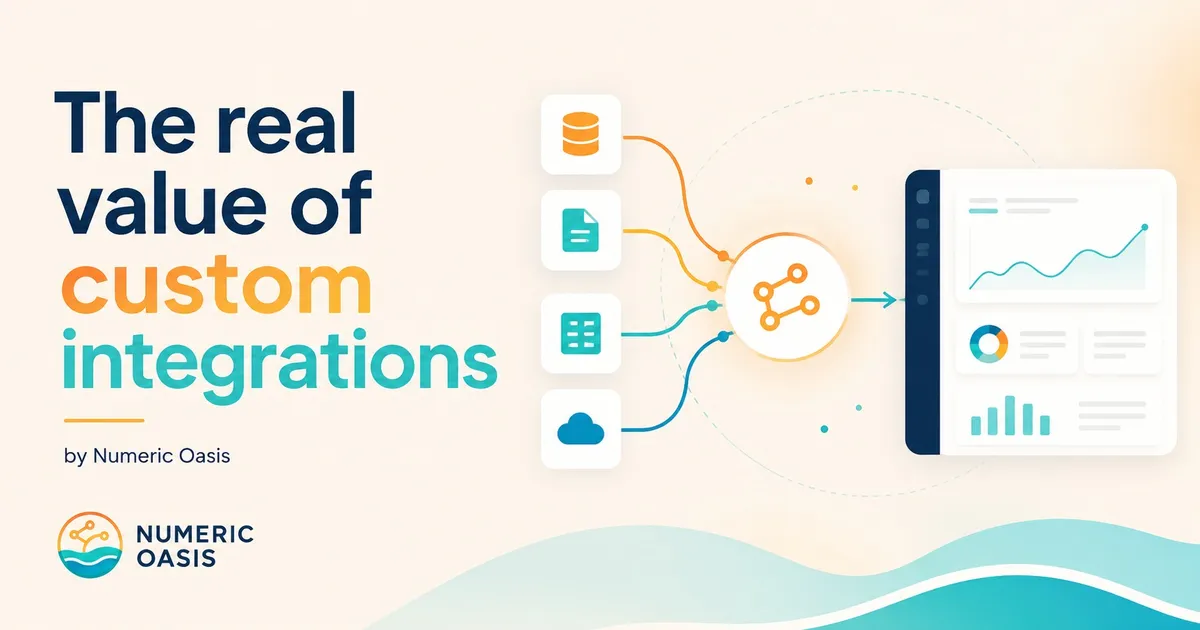
What public industry data, well-known case studies, and our own audits say about building bespoke connections instead of buying generic ones.
The integration tax nobody puts on the budget
Most companies have no line item on their P&L that says “integrations.” Yet integration work is consistently one of the largest categories of IT spend, hidden inside “platform”, “ops”, or “engineering”.
MuleSoft has published their Connectivity Benchmark Report every year for nearly a decade. The recurring finding: the average enterprise runs hundreds of applications, the most recent editions cite well over a thousand, and the top barrier to delivering on digital strategy is integration. Different surveys put the share of IT budget that goes to integration work somewhere between 25 and 50 percent. The numbers move year over year. The directional story does not.
If you cannot find “integrations” on your budget, that is the point. It is not missing because it is small. It is missing because it is everywhere.
What “off the shelf” actually costs you
Generic iPaaS connectors and prebuilt integrations are real software, and for the 80 percent case they work well. The trouble is in the other 20 percent.
That 20 percent shows up as:
- Manual reconciliations because two systems disagree on the same record.
- Glue scripts written by someone who left the company in 2022 and that nobody owns now.
- Subscription costs that scale with usage, where the bill goes up every time a workflow gets popular.
- Vendor data models that slowly shape your business processes, because it is easier to bend the workflow than to bend the connector.
The connector cost is on the invoice. The 20 percent cost is hidden inside engineering hours, finance reconciliations, and the slowness of “almost works”.
Why bespoke wins on quality, not just cost
A custom integration is built for your data model, your edge cases, and your scale. It does not break the day a SaaS vendor’s generic connector falls behind their own API. It does not force your team to map your fields to a vendor’s vocabulary.
The cost story tends to lead the conversation. The quality story is the one that matters more in year two. Less “almost works”. Fewer manual reconciliations. Fewer late-night Slack threads explaining why two systems disagree.
Cost gets you to the buying conversation. Quality is what keeps the integration alive in year three.
What the industry has actually measured
A few public sources worth reading directly:
- The MuleSoft Connectivity Benchmark Report. Every year it reports the share of IT budget consumed by integration, the average count of applications per enterprise, and the share of leaders who name integration as a top barrier to digital transformation.
- The Postman State of the API Report. Annual survey of developers and API teams. Real data on internal API growth, integration patterns, and who owns integration work inside organizations.
- Atlassian Customer Stories. Real named case studies, many of them about integrating Atlassian tools with the rest of an organization’s stack. Worth filtering to the ones in your own industry.
- Spotify Backstage. The public case study and open-source repository for Spotify’s internal developer platform. A canonical example of a large engineering organization deciding that off-the-shelf could not orchestrate their internal integrations, and building a focused alternative that they then opened up to the rest of the world.
None of these are Numeric Oasis case studies. They are sources you can verify, click, and use to pressure-test the argument for yourself.
Scenarios where this matters most
The pattern repeats in four shapes. We see at least one of these in almost every conversation:
M&A integration. Two companies merge and end up with four ticketing systems, three CRMs, and two data warehouses. Generic connectors give you data flow but not semantic alignment. Custom integration is how the merged organization actually starts behaving as one.
SaaS sprawl. Marketing has twelve tools. Sales has eight. Support has six. None of them share clean data. Generic connectors paper over the seams but the report at the end of the quarter still does not add up. Custom integration aligns the data model, not just the wires.
Legacy modernization. An old ERP needs to feed a new analytics platform, or a mainframe needs to start talking to a cloud data lake. Generic connectors exist for the new side and rarely for the old. Custom is how the bridge gets built without re-platforming everything at once.
ITSM and DevOps wiring. Jira Service Management connecting to GitHub, GitLab, or internal deploys. Tickets that close when a deploy succeeds, audit trails that survive across systems, escalations that respect on-call schedules from another tool. Custom integration is how the workflow actually becomes a workflow.
The cost math, plainly
Public iPaaS pricing pages tell the rough story. MuleSoft, Workato, and Zapier all publish tiered pricing for enterprise plans, scaling with connectors, tasks, and volume. Annualized for a mid-sized organization running ten or more integrations on a generic platform, the three-to-five-year total cost commonly lands in six figures.
A focused custom build, plus a small ongoing retainer for maintenance and API tracking, is often in the same neighborhood for the build year and meaningfully cheaper in subsequent years. The custom one is owned forever. The subscription is owned by the vendor.
The actual numbers depend on your contracts and your integrations. The honest way to know is to put your renewal cost and your real integration list next to a scoped build estimate, and read the difference.
The risks, and how to address them
Three risks come up in every conversation about custom integration.
Maintenance load. Custom code requires someone to maintain it. We address this with documentation that survives the engagement, a small retainer for upkeep, and team training so the work is not locked to us. If we stop working together, you keep the code, the docs, and the contact list for every upstream vendor.
API deprecations. Upstream platforms change. Atlassian, GitHub, Salesforce, and every other major SaaS announce breaking changes months in advance. A light retainer covers exactly the migration work that follows. The same risk exists with generic connectors, with the difference that you do not control whether the iPaaS vendor invests in keeping up.
Vendor lock-in. Custom does not eliminate lock-in. It moves the lock from the iPaaS vendor to your own team. The platform underneath is whatever you already trust. The code is yours. That is a trade we think is worth making in most cases, and we will say so when it is not.
Where to start
If you are paying for an iPaaS subscription and still finding manual reconciliations on the team’s plate, the audit is the same shape as for app footprint work. We pull the list of integrations, identify which are load-bearing, which are workarounds, and which would be cheaper and better as a focused custom build.
Send us the rough picture. The systems you connect, what you pay today, and the thing that prompted you to look. We will come back within a working day with whether a conversation makes sense and the rough shape of what a custom path would look like.
The services we run are described on our services page. If part of your integration spend is concentrated in the Atlassian Marketplace, the Atlassian app cost reduction page is the right starting surface. Otherwise contact us is the place to begin.
Custom integration is not the answer for every connector on your bill. It is the answer for more of them than most teams realize. The audit is how we find out which.
Share